Friday, July 17, 2009

Bookmatching and Equilibrium and Ed Goode's Six String Bass


Small pleasures: I will walk across the street to look closely at a car if the logos on the hubcaps line up. If I am waiting for a green arrow traffic light and the blinkers on the car in front are in synch with mine, I smile.

When the outside temperature and inside temperature aligned recently, I grabbed my camera (see image).

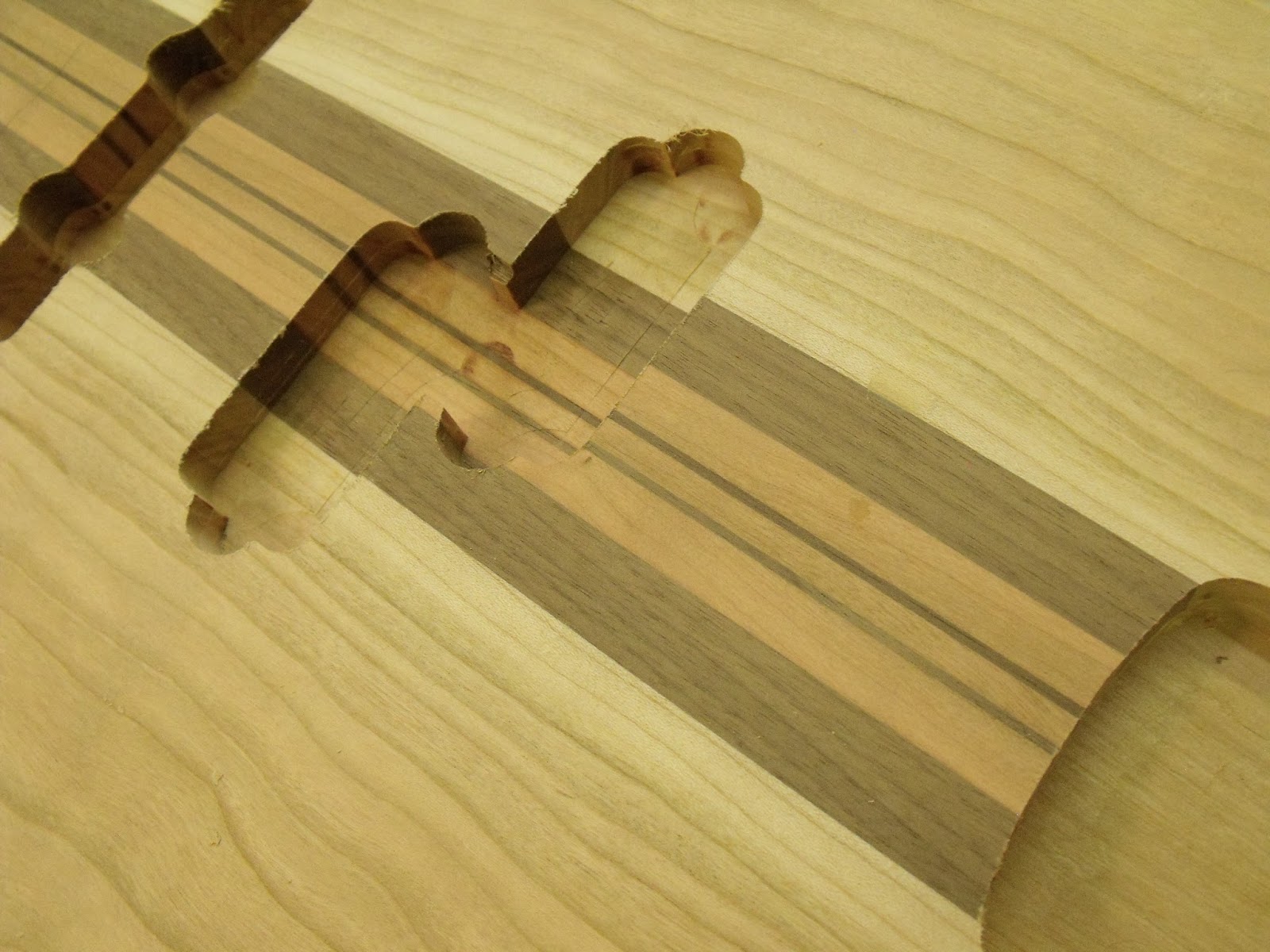
Bookmatching wood brings the same kind of delight to this instrument maker.

The process is simple: A board, thick enough to warrant getting sliced in two and narrow enough to fit in the larger bandsaw (7.5 inches) gets opened up to reveal mirror images. It's a traditional look on acoustic instruments, including the violin family and ranging through all the fretted instruments even into electrical ones.

How this came about is unclear but perhaps this explains: Resawing was the way to make larger boards into thinner ones (imagine apprentices working a pit saw) and, in the interest of speed, boards were arranged and glued edge to edge to make larger boards and put onto instruments. But some, by chance bookmatched, looked more interesting and pleasing than others, and thereupon became the gold standard.

Even resawn, the boards for Ed Goode's six string Barker Bass offer choices: They can be arranged A edge to A edge or B edge to B edge (see the drawn figure; select two boards for one type pattern, move over one board and look at the two boards for the alternative).

Then I look for how the pattern will appear on the body. The body's lower bout (widest portion) is the larger palette--it is not interrupted by pickups, bridge and controls. I like to see visual weight there, preferably about centered on each side.

In cabinet making, the rule for bookmatch is "cathedrals up" which means arches or arrows point vertically. Often on the Barker I look for an arrow down in the center so the long, triangular tailpiece sits roughly parallel to those lines. (You can see this illustrated in a pair of the boards in the sketch.)

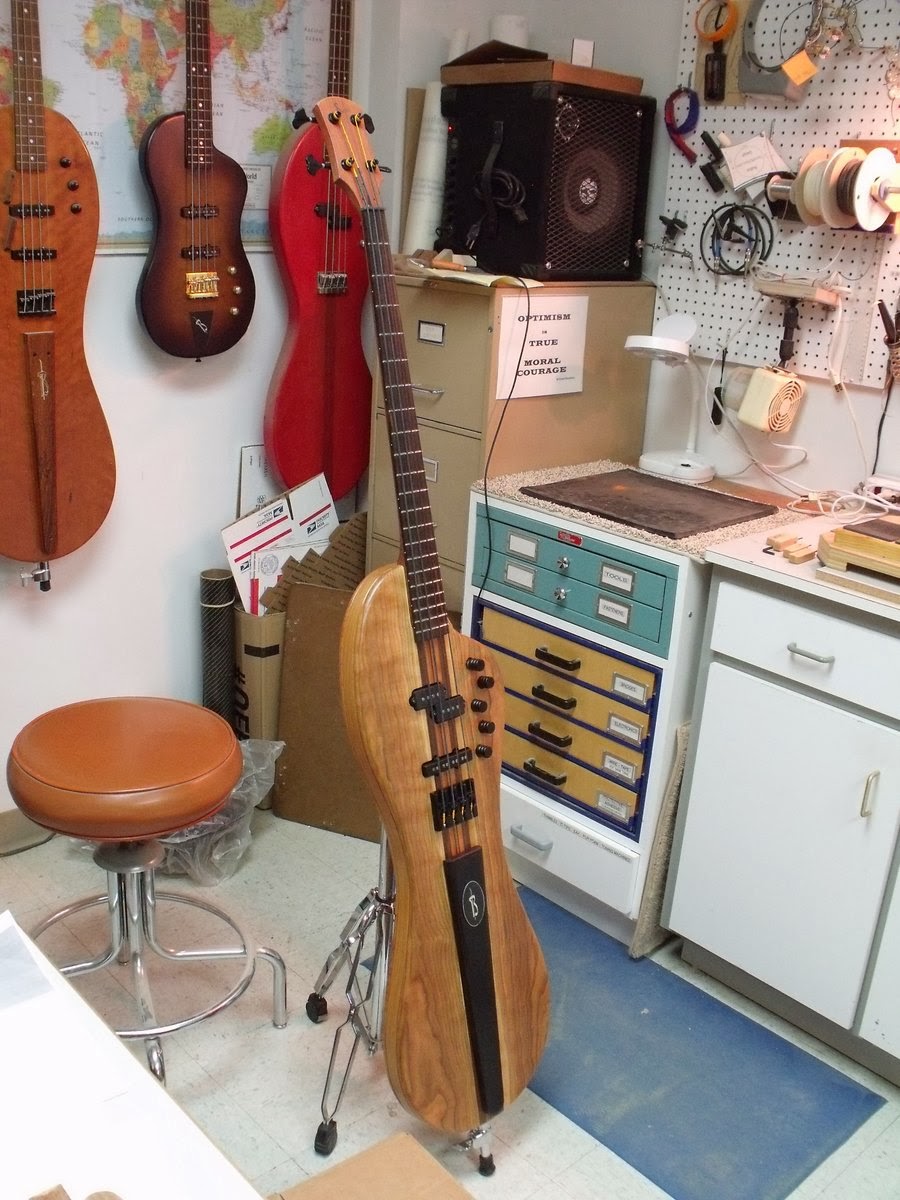
It's a privilege to be making these decisions. As for Ed's bass, the rare curly fir pattern is so consistent throughout that finding a nice mirrored puff for the lower bout was the only decision required.

And that other picture, of the fence in the alley about four blocks from our house? Look closely--two are bookmatched!

Harmony and symmetry surround us, there for our delight.

Wednesday, July 8, 2009

Wheeler County Bluegrass Festival: Meet CinderBlue


Through the graciousness of Jay Bowerman and his band, Quincy Street (of Bend, Oregon) we were invited to the Wheeler County Bluegrass Festival last week to join them on stage for a few tunes during their gospel set on Sunday morning.

This is our third time out: Meet CinderBlue: Marlene Stevens, vocals; Jeff Stevens and Rex Gatton, guitars; Lee Barker, bass.

The venue: The lawn of the county courthouse. The Friday night-Sunday event includes name bluegrass acts, a local songwriter's contest--and the song must be about Wheeler County or the county seat, Fossil itself--a gospel scramble, area acts, wonderful food vendors, a car show (across town--two blocks away, that is) and the most attentive, relaxed and delightful crowd you could dream up. Bluegrass, unlike many genres, is multigenerational and it fosters that unashamedly. We had a great time.

Takeaway observations: (A) By far most bassplayers at this event were women. Ten to one, I'd say. (B) There are frighteningly talented children--and I mean single digits in some cases--on their way up, carrying the High Harmony, Acoustic Instrument flame forward through the ages. (C) Diana, who did the sound, was the most efficient and versatile boardmaster to come along in a while. (D) My anxieties about appearing onstage with a non-doghouse bass were for naught. I was not run out of town on an electric rail, and many folks in fact commented on how good the bass sounded. And a nearly equal number had seen the piece on Oregon Public Broadcasting and enjoyed connecting the loop via hearing the bass in person.

Bottom line: We're invited back next year. We wish it were tomorrow.

Friday, July 3, 2009

The Fourth of July Parade in Redmond Oregon


It started last fall when the neighbor hit a root with his aging riding mower. "I can fix it," he said, and he's a resourceful guy. "You'll never find a new shaft for a 20 year old mower," I replied, and I won that one. I was doing figure eights in the driveway when Linda came home from work that day.

Months of effort later, with significant help from my friend JD who furnished the pressure tank and the wand and inspiration, we have the Parade Entry #64

Shooting water was always at the core of the endeavor. Shooting it surreptitiously came later.

The water exits the wand at about 7' from the ground, a few degrees from vertical, meaning it is heading forward. It goes up to about 16 feet then returns to ground about 21 feet downrange.

I can drive the tractor at walking speed, extend my hands sideways, palms up, in an, "I'm totally innocent" sort of gesture and nudge the trigger with my left shoulder and someone may get wet. If I go much faster than walking speed, I get wet, running into my own bullets as it were. Either outcome is good for a laugh.

It will be 90 degrees for the parade. I expect a hero ribbon, but it's more likely a certificate that says "participant."

Total cash outlay for the project--less than $100, including the $50 to get the busted mower in the first place.

My friend Chris has taken his tractor-type mower and made it into a 9 foot long dragster. Photos of that one later.

Time to line up. And try to find a place that's not behind the mounted posse. Or a float with a lot of water-soluble crepe paper.

Monday, June 22, 2009

"...Booked out and bound to go..."


Big Bill Broonzy: "I got the keys to the highway, booked out and bound to go..."

Mike in Westminster, Maryland purchased a Barker Bass and it set out on the journey last week.

But before that, well, here's your behind the scenes peek. Though the inventoried basses hang in a pretty clean room, it's not perfect. Dust, like a desperate pilot, always finds a place to land. (You can get a feel for this room, including the photo corner, on this Oregon Art Beat segment from Oregon Public Broadcasting.) So first, cleaning. Compressed air first, microfiber cloth next.

Then to the bench for setup as if it were just assembled: Neck relief, string height, string spacing, string radius, pickup height, tuning, intonation and checking for the proper amount of Barker Mojo Fluid.

From there, back to the SemiClean Room for playing, double checking the feel of everything, noting the balance of string tone, and snugging down the Mojo Fluid Dipstick.

Wrapping is a little more involved than you might think, with protective foam between the strings and fingerboard, new, clean plastic sleeve over the whole instrument, custom cut foam blocking (the same foam insert in the custom box accommodates all three sizes of Barker body, provided this little added block is right) and then inserting the stand and bag set in the box, making sure the owner's manual is in there along with the wrench for string height adjustment.

Once all that is done and double checked, the final strapping goes on. It's ready to

"...leave here runnin', 'cause walkin' is most too slow."

It's a triumphant, top-o'-the-world feeling to have brought this instrument from nothing to something, attempting to instill in it my ideas about quality and beauty and joy, hoping that will be reflected through the hands of the new owner and into the ears of those who hear her or him play it.

Mike, welcome to the Barker family. She'll be at your door soon.

Monday, June 8, 2009

The Math of Dirt


The long range plan: Replace the lawn between the sidewalk and the street--sometimes called "the parking" or "the terrace"--with pavers.

The motivation: conserve water and reduce mowing.

The steps so far:

1. ad on Craigslist: "free sod--you cut, you load, you haul." A young couple answered, did a great job.

However. That sod--50 years old--had grown tall with years of accumulated normal thatch decomposing and, in effect, creating soil. Setting the sodcutter at its greatest depth still left the remaining soil about even with the sidewalk and the curb.

"You've got a lot of dirt there, Lee," was the common comment from Those Who Know.

We enlisted the help of Rex (guitar player and contractor) and his wife Sharon and grandson Chance, and JD, manager of his rentals and owner of a stunning home which he built by himself up in the Ochoco mountains. And among JD's credentials, maybe the topmost: He owns a tractor with a bucket. Add Linda and me, and you've got the crew portrait.

The soil to be removed measured thus: 3 inches (depth of paver) by 588 square feet. If one focuses on the inches, it doesn't look like much. But what you have is 147 cubic feet, which is nearly 5 1/2 cubic yards--a small dump truck full.

It wasn't all tractor--shovels, landscape rakes, buckets of rocks up to large grapefruit size (and two marbles and a few shards of a flowerpot).

Little barbecue in the middle of the day.

JD dumped the surplus soil over the fence in the back yard, raw material for Linda's dreams of berms and plantings.

I can't grasp the work it would have taken to get it there by wheelbarrow.

By 5 o'clock the paver area was raked free of rocks and roots and screeded to depth. Amazing.

Now it gets easier.

Love your friends.

Thursday, May 28, 2009

Cleared For Takeoff


The presence of a few twigs on the front porch coincided with the breezy part of spring, during which the local elms give up detritus stored through the winter when things are just not attended to by the Branch Manager.

Then we realized the robins were back. Likely it's the same pair that tried this last year and then, experiencing our coming and going and violating their construction zone, moved twenty feet west to the identical light fixture on the front of the garage. We enjoyed their courtship and shared effort in the construction. That fixture being lower allowed us to easily hold a camera up and snap the eggs, the hatch, the supersonic growth and the eventual launches.

This year, the garage was not attractive to the birds so we blocked off the front door and let Mother Nature nurture.

One half an eggshell appeared on the lawn. We feared the starlings had raided. But Linda's artfully held camera revealed at least 4 hatchlings. Now they're ready to go, all five of them! The image above was taken just before writing this on Thursday May 28. The alpha baby was wanting to do some demo flapping for the photographer, but a watchful parent dived at me. I found myself encouraged to get the heck away.

When I head home for lunch today I expect to see one or two gone. Not that I'm an expert on birds. Or on kids.

But I recall Peter Guy's first day, first grade, as I watched him walk away from me, down the sidewalk.

I remember saying goodbye to Joel, dormitory Freshman, after we unloaded his stuff at Southern Oregon University in Ashland. LiAndra shoehorned into her little red car, off to Iowa. Joe and Sarah, married and gone to fashion their own life and family.

All of them fledged and flew.

"Empty nest" is apt. A little sad, a little prideful, a moment in life when you hear that otherwise inaudible click and know that things have changed at this very moment.

Linda and I will enjoy reclaiming the use of the front door and our mailman will appreciate free access to the mailbox. Life will return to normal.

I just wish those little birds would send a postcard every now and then. Living mostly in a two dimensional world, we could learn from those who live in three.

Friday morning postscript #1: Alpha Baby Robin popped from the nest last evening and spent at least an hour hopping around the yard. Parents were always within sight, sometimes on the ground, sometimes perched above. At dark we lost track of both.

This morning, four still left in the next, enjoying the roominess. Parents still bringing groceries at an exhausting pace.

Monday Morning postscript: By Saturday evening all 5 were gone. Linda and I were fortunate to see flight #1 of Gamma Robin, from the nest, straight line to the Ponderosa, about 20' as the, er, robin flies. The parents stayed attentive throughout the major exodus, not only keeping track of the boots on the ground but also the in-training class still doing wing-flapping calisthenics in the gradually uncrowded nest.

I've added an image of one of the adolescents, could be Gamma, or Delta, or even Epsilon. Instinctively, when they're on the ground, they stay around cover, as this one was, close to the flower bed. From the back they look pretty drab, but on the front the speckled breast is charming. I had no luck getting close enough for that kind of shot. Besides, one could only imagine the hullaballoo over publishing such an image.

We're enjoying using the front door again, but a little sad that the drama is over.

Wednesday, May 20, 2009

Introduction to the Ed Goode Six String Barker Project


He bought his Barker Bass used, so I never really got to know him until his writings--terse, direct, entertaining, well spoken--showed up on the Barker Bass forum and elsewhere, always with kind and enthusiastic tidbits about his relationship with this vertical bass. I started paying attention to Ed Goode

Then the hammer. He wanted a six string. He is one of an elite crew, the Extended Range Bassists, who have used the bass as a vehicle to explore not only new sonic territory but to challenge conventions of building the very instrument. Stew McKinsey comes to mind, as do others such as Gregory Bruce Campbell.

One of the builders who consistently rises to the top in this realm is fellow Oregonian Fred Bolton who consistently pushes himself and his designs into admirable results.

So with a confluence of gently unrelenting pressure from Ed and inspiration from players and builders, I figured out a way that I could sidle into this genre of instrument without a full-on retooling away from the heart and soul of the company--the four and five string Barker basses.

Ed leapt at the opportunity, which required him to furnish me with a 6 string bass guitar of his liking. From that, to reduce the process to a mere line, I have the components to produce exactly what he is looking for: The Good Stuff of a Barker with Much More String!

In the images above you'll see the very rare wood which will grace the front of this bass: quilted fir. I had just a few boards to select from, and this one wins because of consistency of pattern and color match. Both sides are shown. The board will be resawn and bookmatched for the front of the bass. Also note how the colors in the fir bring out the reds and browns in the rosewood fingerboard.

From time to time I'll bring you up to date here on this process, which will be interwoven with another effort in the shop which, in a sense, heads quite the other direction but is driven by enthusiasm equal to that of Ed. Soon you'll meet Craig.

Without these two bassists, this could have been Just Another Summer.